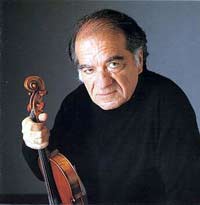
"Basics" and "Practices" are equivalent to 小提琴的百寶箱,什麼都有。作者 Simon Fischer 最近有很多東西都在 youtube 上面。最主要是在澳洲的workshop。請大家自己去看一下,過一陣子我會把那些連結放上來,加一點中文注釋,方便對英文不是很熟悉的同好。
=============Part 1 - 音準的四個階段===============
音準有四個階段
- 結構性音準: 具有一致性,聽起來是完美沒有問題的,像是海飛茲的錄音。
- 結構性音準但是有錯誤: 具有一致性,但是會有錯。
- 無結構性音準: 音會不準,但是還具有一致性。
- 無結構性音準但有錯誤: 就是亂七八糟。
=============Part 2 - Acoustic Beating and Tunning===============
這個真的要仔細聽,基本上音不準的時候(一度五度八度)會有pulsing/beating。調音的時候就是要把那個beating弄不見。調音的時候是先調A,在把其他的弦對著A調。
=============Part 3 - Tunning===============
在不確定音到底準不準的時候,把手指放到被調整的弦上,稍微提高一點。要是聽起來比較好,那就是音太低,反之那大概就是準的了。
=============Part 4 - 持琴的高度===============
琴要與地板平行。當琴與地板平行的時候,弦已經微微的朝下,當琴持的太低的時候,弓會一直滑開到指板的地方。拉琴的感覺是 "抱著琴橋" 拉琴。
==========================================
有人已經寫出來了~~
Simon Fischer Intonation Workshop Four Levels of Intonation
Structured and unstructured intonation represent four levels of intonation. Intonation in this spirit is not only playing in tune, but producing resonant singing notes. There is very interesting math and even physics in the relationship between notes and the quality of the tone produced that is common to all instruments in some way, 'but especially important to bowed string instruments'.
Level 1: Structured--all notes related to each other--consistent, holds, no mistakes. Heifetz shows nobody plays in tune when slowed down to half speed--many notes are out of tune, but it give the impression of playing in tune. That is level 1 intonation. Is Heifetz level 1, or level 2?
Level 2: Structured with mistakes--mom doesn't notice but you do. It's still good very, because we are human. We don't want to be machines anyway. Fischer takes us to level 2.
Level 3: Unstructured: In a major arpeggio, maybe high then low c#'s in the arpeggios. Still ok, but heading in the wrong direction.
Level 4: Unstructured--with mistakes--it's all over the place. To go go from unstructured on this level to structured level 2, one can do in hours rather than years; and is, the topic of this workshop.
Getting to perfect structured (level1), can take years, but to get to level 2, it simply takes hours. "If one spends 10 minutes 3-4 times/week one is minutes away from structured intonation".
Simon Fischer Intonation Workshop Acoustic beats and tuning
Lesson Number one for students: Tune the violin. The first thing Fischer shows anyone is "acoustic beats". If you have one 'a' tuned at 440, and play another a-beside it the tones are in synch. If one is 440 and the other 438, it creates the "acoustic beat".
An acoustic beat is a dissonant pulsing that is easiest heard by experimenting by playing octaves 'barely' out of tune. "When we tune, we are getting rid of the beat". We must learn, to listen. Listening becomes the subject from the very very beginning. What does this mean to unstructured and structured intonation above? Later we will see it actually means a lot. The violin (and bowed stringed instruments in general) have a relationship between the notes and strings, whereas a singing resonant note is actually effected by adjacent strings. This becomes very important in intonation..
Simon Fischer Intonation Workshop Tuning Continued
Previously Fischer talked about getting rid of the acoustic beat. In this video he shares his trick for truly hearing if the acoustic beat is gone. One can lightly (very lightly) press the adjacent string when using 5ths by ear, just at the front of the nut to fine tune. Very lightly. The result is that it makes the two strings different in very subtle ways where one can hear if an acoustic beat is present.
Simon Fischer Intonation Workshop Angle of the Instrument
This video is Simon Fischer's remarks on holding the instrument up just a little to keep the strings parallel to the floor; and, on good posture as an aside. But this posture, nearly as physics-bound as sympathetic vibrations we will hear about in a minute, and the acoustic beat gets into the effect of being relaxed with strings parallel on intonation--and I find it very true. And part of this posture, besides straight back and neck, is a relaxed center-line up the neck, not scrunching, and while not being stiff at all as we will learn later, it does mean conserving motion.
Simon Fischer Intonation Workshop Concept of a note
Perlman asked about the difference between Galamian and De Lay:
Galamian would say: "Sharp! Flat!"
De Lay: "What's your concept of a note?"
The point: Leading edges of notes when playing for doubles stops as the example, shows that the third note in a double stop is movable. And the spirit of the law again, per both Fischer and Perlman, is listening to one's self.
Fischer goes on to illuminate the nature of sympathetic vibrations, and implies how this can improve one's listening to their playing. So to apply what I learned from Fischer in this, I created a little exercise using the Children's Song "Chopsticks" on open A and D-stopped, or other strings if wished. This really illuminated those half-steps.
Sympathetic vibrations is the fact that if I play G on D string, my G string vibrates in different sections of the string on it's own. And if I play A on G string, my A string vibrates along in a single place along the string. This nature of bowed-string instruments to 'excite' other strings is important to intonation, and I think understanding this is probably what is getting 'me' there in these ways--you can hear what he says here with just a little work.
The spirit::Mr. Fischer makes an important point unrelated to the "concept of a note" in this video. He tells the story of someone asking "why do we need to know all of those things". Is listening not enough? He continues telling that he later had a conversation with Dorothy Delay, that explained 'clearly' why details are important.
'Every technical exercise, and every detail are opportunities to refine one's playing. I will not debate the idea of not working on being knowledgeable, and focusing on small details. And I will be bold enough to say, it is simply true. Even beyond basic general competency which is a world of work of itself, is a journey towards improved and never ending artistry. And ironically, it still gets back around to listening'. (Fiddler at the Cove)
Simon Fischer Intonation Workshop Cause and Effect:
Make simple changes to improve steadily. Listen to yourself(causes), make simple changes for better intonation and tone(effect). Both teachers and students--do whatever is necessary, if repeated fifty times, to break those things causing unacceptable results. 'If you are a beginner, it feels like forever being able to even understanding what cause is effecting, but it gets a little better over time'. 'This is so very true.'
Simon Fischer Intonation Workshop Expressive Intonation
This important video brings everything Fischer has talked about so far, in improving intonation. From acoustic beats in tuning, to sympathetic vibration, one learns that many of those dead sounding notes are not a flaw in the instrument, but a flaw in finger placement; and, Fischer relates this to sympathetic vibrations both above and below the stopped(pressed) note.
Open strings and their stopped counter-parts creates the first part of a framework to improve intonation when used with the idea, actually physics of sympathetic vibrations.
Fischer gets to the heart of defining Expressive intonation based on the observation of Casals the great cellist.
The principle is that on piano a-flat is a-flat, and g-sharp. On violin and string instruments a-flat can be played lower, and g-sharp higher(leading edge). But Fischer notes that we cannot always play with expressive intonation, based on the venue such as string quartet, or maybe with a piano and so on.
Fischer goes on to fill in the framework mentioned by showing how to get at a-flat by feeling (not forcing) the finger against the nut. But the real point in this is that sharps
lead up and flats lead down. So it only reasons that a-flat would be played on the lower edge from the center of the note, and g-sharp on the higher(or leading) edge from the center of the note.
As he began in the beginning of this workshop, expressive intonation is all about measuring the relationships between notes and their respective or related notes, and applying these distances well and appropriately. But it goes somewhat deeper than this. Intonation in the spirit of this workshop, has a direct impact on the quality of a single, and nearly every note.
Finally, using the techniques Fischer shared, he reminds again, that anyone can get to a solid level 2 structure of intonation in minutes a day, rather than years.